
Legend
- Which model for coding? The honest answer
- How we judge a coding model
- Best AI models for coding, ranked
- AI model comparison for coding: the table
- How to actually use them (without juggling 6 accounts)
- FAQ
- What's next?
Which model for coding? The honest answer
Every week someone on our team, or in the Creative Tim community, asks the same thing: "What is the best model for coding right now?" And every week the honest answer is the annoying one. It depends.
I know. Nobody wants to hear that. But after a year of running agents on our own codebase, paying real invoices for it, and switching models more times than I'd like to admit, here's what I've learned: the "best" model changes with the job. Long agent loop inside Claude Code? One answer. Bulk refactor across 400 files? Different answer. Autocomplete that fires 2.000 times a day? A third one.
So this post isn't a single winner. It's a ranking with the trade-offs spelled out, real prices per million tokens, and a way to switch between all of them without re-integrating your stack every time a new model drops. Let's go.
How we judge a coding model
Before the picks, here's the scorecard we use. Four things. Nothing else really moves the needle.
1. Tool-call reliability. A coding model lives inside a harness: Claude Code, Cline, Cursor, your own agent. It has to call edit_file with the right arguments, every time, for 80 steps in a row. One hallucinated path and the whole run is garbage. This matters more than raw "intelligence."
2. Context window. 128k is fine for a feature. 200k handles most services. A million tokens means you can drop an entire codebase into one call and ask "where is this bug coming from?" Different jobs, different needs.
3. Cost per completed task. Not cost per token. A cheap model that needs three retries costs more than an expensive one that nails it first time. We look at what a finished PR actually costs.
4. Open vs. closed weights. Open-weight models give you the option to self-host later, and they've gotten frighteningly good. Closed models still lead on the hardest reasoning. Both belong in your toolbox.
Keep those four in mind. Everything below is scored against them.
Best AI models for coding, ranked
Prices are per 1M tokens, input / output, at metered rates. Accurate as of 7 September 2026.
1. Claude Sonnet 4.5: the default coding agent brain
$3 / $15 per Mtok. 200k context.
If you only pick one, pick this. Sonnet 4.5 is what we run by default in our agent loops, and the reason is boring: it just calls tools correctly. Low hallucination on file edits, strong understanding of a repo it's never seen, and the best tool-calling reliability per dollar in the list. Wire it up through the Claude Sonnet 4.5 API and you're done for 80% of tasks.
2. Claude Opus 4.6: the step up for hard problems
$5 / $25 per Mtok. 200k context.
Same family, more brain. We reach for Opus 4.6 when the task is architecture, not implementation: "redesign how auth flows through these 12 services" instead of "add a field to this form." It costs about 1.7x Sonnet, so don't leave it on for everything. Use it as the senior engineer you call in for the ugly stuff.
3. GPT-6 Astra: the whole codebase in one call
$10 / $50 per Mtok. 1.05M context.
OpenAI's September 2026 flagship, and the most expensive model here. The pitch is the window: 1.05 million tokens means a full mid-sized repo fits in a single request, with reasoning-effort control so you decide how hard it thinks. At $50 per million output tokens you won't run it in a loop all day. But for "read everything and tell me what's wrong," nothing else in this list does that. The GPT-6 Astra API is the page to bookmark.
4. GPT-5.5: the cheaper OpenAI flagship and a great second opinion
$5 / $30 per Mtok. 256k context.
Half the price of Astra, strong general coding, and the model we use most as a reviewer. Have Sonnet write the PR, have GPT-5.5 review it. Two different model families catching each other's blind spots is one of the cheapest quality upgrades you can make.
5. Kimi K3: the open-weight agent specialist
$3 / $15 per Mtok. 256k context.
Same price as Sonnet, open weights, and tuned specifically for agent harnesses like Claude Code and Cline. If you're building your own agent loop and want a model that behaves well over many tool calls, K3 is the open-weight answer. It surprised us. We expected "cheap Claude." We got something that holds its own in long runs.
6. DeepSeek V4 Pro: the value pick for volume
~$1.32 / $3.96 per Mtok. 128k context.
Open-weight, near-frontier code edits, at roughly a quarter of Sonnet's price. This is the model for the boring 70% of work: migrations, test generation, "apply this pattern to 60 files." The 128k window is the limit, so keep tasks scoped. The DeepSeek V4 Pro API pricing is the reason we moved our bulk jobs over.
7. DeepSeek V4 Flash: the bulk and autocomplete tier
~$0.44 / $1.32 per Mtok. 128k context.
The cheapest serious-quality coding tokens on the list. Autocomplete, inline suggestions, quick "rename this and fix the imports" jobs. Anything that fires thousands of times a day belongs here. Don't ask it to design your system. Do let it save you money on everything else.
8. GLM-5.2: the open-weight challenger with a free tier
$1.4 / $4.4 per Mtok. 128k context.
Strong coding, strong reasoning, open weights, and a generous free tier that makes it the easiest model here to try before you spend anything. It sits right between DeepSeek Pro and the closed frontier on price, and it punches above that.
9. Gemini 3.7 Flash: cheap plus a huge window
$0.75 / $3.75 per Mtok. 1M context.
A million tokens of context at under a dollar per million input. That combination is unique. It's the model you leave running on repo-wide, high-volume tasks: "scan the whole monorepo for deprecated calls and list them." Not the sharpest editor here, but for wide and cheap, nothing beats it.
AI model comparison for coding: the table
| Model | Price (in / out per Mtok) | Context | One job it's best at |
|---|---|---|---|
| Claude Sonnet 4.5 | $3 / $15 | 200k | Default agent brain, reliable tool calls |
| Claude Opus 4.6 | $5 / $25 | 200k | Hardest reasoning and architecture |
| GPT-6 Astra | $10 / $50 | 1.05M | Entire codebase in one call |
| GPT-5.5 | $5 / $30 | 256k | Cheaper flagship, second-opinion reviewer |
| Kimi K3 | $3 / $15 | 256k | Open-weight agent loops |
| DeepSeek V4 Pro | ~$1.32 / $3.96 | 128k | High-volume edits at low cost |
| DeepSeek V4 Flash | ~$0.44 / $1.32 | 128k | Autocomplete and bulk tokens |
| GLM-5.2 | $1.4 / $4.4 | 128k | Open-weight challenger, free tier |
| Gemini 3.7 Flash | $0.75 / $3.75 | 1M | Cheap, repo-wide scans |
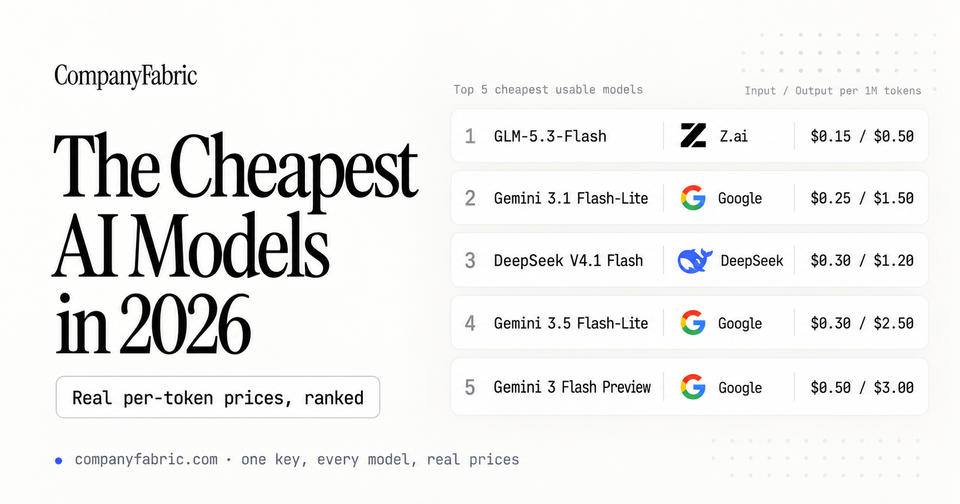
Read the table top to bottom and one thing jumps out. The spread between the cheapest (Flash at $0.44 input) and the most expensive (Astra at $10 input) is more than 20x. That's not a rounding error. That's the difference between an AI bill of $200/month and $4.000/month for the same team. Picking the right model per task is where the money is.
How to actually use them (without juggling 6 accounts)
Here's the part nobody tells you when you read these rankings.
Using the best model for each job means using four or five providers. Anthropic, OpenAI, DeepSeek, Moonshot, Zhipu, Google. Each with its own account, its own API key, its own billing page, its own rate limits, and its own slightly-different request format. We did this the hard way for months. Somebody would forget to top up one provider and half the pipeline would die on a Sunday.
It's the same thing as paying for groceries with six different cards at six different shops. Possible. Stupid.
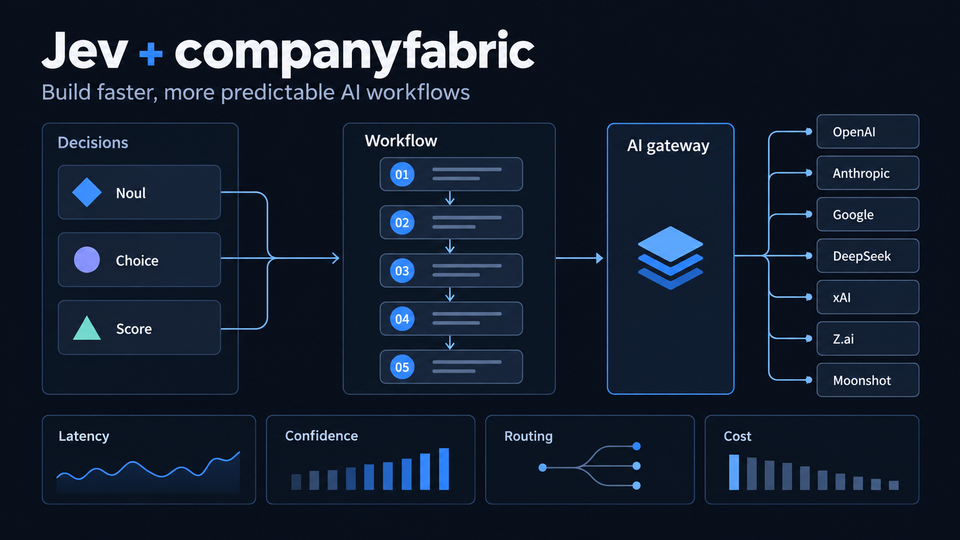
The practical fix is a gateway. We use CompanyFabric, which is one API for every model above: one key, one prepaid balance, one rate limit, OpenAI-compatible format. Switching from Sonnet to DeepSeek is a one-line change to the model name, not a re-integration. Every model's exact per-call price shows up before you run it, so nobody gets surprised by an Astra invoice. And if you already have keys with a provider, bring-your-own-key is a 0% platform fee.
You can compare the coding models side by side there too, which is how we sanity-check prices before moving a workload.
What this gives you in practice is a routing setup, and it's the single biggest cost win we've found:
- Agent loop (Claude Code, Cline, your own harness): Sonnet 4.5. Fall back to Kimi K3 if you want open weights.
- Hard architecture question: Opus 4.6, or GPT-6 Astra if the whole repo has to fit.
- Code review on the PR the agent just wrote: GPT-5.5.
- Bulk edits, migrations, test generation: DeepSeek V4 Pro.
- Autocomplete and anything high-frequency: DeepSeek V4 Flash or Gemini 3.7 Flash.
One key, five models, each doing the job it's cheapest and best at. That's the whole strategy.
FAQ
What is the best AI model for coding right now?
For most developers, Claude Sonnet 4.5 at $3/$15 per million tokens. It has the most reliable tool calling per dollar and handles unfamiliar repos well. If you need a million-token context or the deepest reasoning, GPT-6 Astra takes over, at roughly 3x the price.
What's the best Claude model for coding?
Sonnet 4.5 for day-to-day agent work and implementation. Opus 4.6 ($5/$25) when the task is architecture or a problem Sonnet keeps getting wrong. Same 200k context on both, so the choice is purely about how hard the problem is versus what you want to pay.
Which is the best free AI model for coding?
GLM-5.2 has the most generous free tier in this list and is a serious coding model, not a toy. If you want to try several without spending, CompanyFabric keeps a list of free AI models you can hit through the same key.
Best AI for code generation?
For one-shot "write me this function" work, Sonnet 4.5 and GPT-5.5 are both excellent and GPT-5.5 is a good reviewer of Sonnet's output. For high-volume generation, like tests or boilerplate across a whole project, DeepSeek V4 Pro at ~$1.32/$3.96 gets you near-frontier quality at a fraction of the cost.
Cheapest model for high-volume coding?
DeepSeek V4 Flash at ~$0.44/$1.32 per million tokens is the cheapest serious option. If the task needs a big context window, Gemini 3.7 Flash gives you 1M tokens at $0.75/$3.75. Use these for autocomplete, scans, and anything that runs thousands of times a day.
Which is the best reasoning model for coding?
Claude Opus 4.6 for reasoning inside a normal 200k context. GPT-6 Astra when you need reasoning-effort control and a 1.05M window to hold the entire codebase while it thinks.
What's next?
One line to take with you: there is no single best AI model for coding, there's a best model per task, and the win is being able to switch between them in one line.
We're going to keep running these models on our own products and publish the numbers as they change, because the ranking above will look different in three months. That's just how 2026 works.
If you want to try this routing setup yourself, grab one key and run all nine models through it. It's the fastest way to find out which one actually earns its place in your workflow.
Thanks for reading! If you have feedback, corrections, or your own numbers on what a finished PR costs you with each model, I'd love to hear them. You can find me here: Twitter/X and LinkedIn.